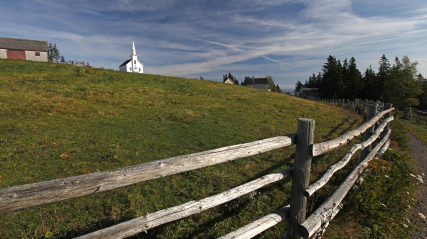
The Céilidh
A session in the céilidh-house would usually begin with polite inquiries as to how everyone ’s family and relatives were doing and move on to everyday news. After these formalities, the real storytelling could begin. Guests were especially fortunate if the céilidh was attended or hosted by a sgeulaiche, an exceptional storyteller who would be well versed in sgeulachdan. These are full length, elaborate tales which could sometimes take several evenings to tell.
General conversation was the basis of interchange although seanachas played a prominent role as a source of entertainment and informal education. Seanachas, which is oral tradition, is the ground floor for the Gaels’ intellectual life. Going beyond light conversation, seanachas topics were inclusive, raising points for discussion on such important subjects as tales, legends, fairy-lore, genealogies, proverbs, local history, and songs. Occasionally, music and dance would round out the visit. Cape Breton is distinct in that, to the present day, the Gaelic culture and language have been maintained outside of the mother country and it is truly a North American Gàidhealtachd.
In fact, regarding instrumental music and dance, the Gaels of Cape Breton have preserved older cultural forms that have been lost in Scotland. In recent years, Cape Bretoners have been reintroducing these to the Scottish Gàidhealtachd.
Gaelic Songs
Songs were composed within the aesthetic bounds of the old tradition and also dealt with New World subject matter. They conveyed love and pride of place, the deaths of outstanding persons, humour, satire, religious devotion, drinking, and the chronicling of local events and historical material. Village poets ‘made’ songs about local contemporary events and characters. These songs were addressed to a local audience and although they may sometimes have served a moral function were mostly for amusement. The poet was both chronicler and critic.
For Nova Scotia Gaels, livelihoods were derived from the land and sea. Communal co-operation such as milling and spinning frolics lightened the labour of individuals while maintaining linguistic, cultural and social bonds. Men and women would join together to assist their neighbours while singing songs appropriate to the task at hand. In this way large jobs, such as building a bran or school, would be completed quickly.
Gaelic Cape Breton can boast the retention of a vast corpus of work songs. Singing, often communal singing, helped to lighten the burden of any heavy or repetitive work. The origin of many of these can be traced back hundreds of years. These included lullabies, sailing songs, milking songs, spinning songs and òrain luadhaidh or milling songs. A luadhadh or milling frolic was quite a spirited event and was organized to shrink the homespun cloth when it came off of the loom. In Scotland, the luadhadh was traditionally women’s work, but the custom evolved in Cape Breton to include men in the work and singing.
Video Caption
Hoireann o ra ì ù a, Seumas
Video Credit
An Drochaid Eadarainn
Music and Dance
Slow airs, marches and dance music consisting of strathspeys, reels and jigs were the forms of music played. Very often fiddlers adopted pipe tunes into their own repertoires and it was not uncommon for the same individual to be a piper, a fiddler, a dancer and a singer. Musicians usually learned informally at home from friends and relatives and very often instrumental music, like the other Gaelic cultural expressions, was passed down through families. Music and dancing were always practiced in the homes and as time went on dances were held in schoolhouses and, after the turn of the 20th century, in community halls.
The Gaelic piping tradition was maintained and passed on for several generations and community pipers were to be found wherever Gaelic was spoken in Cape Breton. Similar to fiddling, there were strong lines of transmission within piping families.
Dancing could occur in many social situations but was especially prevalent at community picnics, weddings, frolics, house parties, and later at schoolhouse and parish hall dances. It also took place at crossroads, in barns, on bridges and even on tree stumps!
In solo performance, a dancer was expected to be erect in posture, with the body remaining rigid from the knees up. He was expected to be light of foot with steps performed neatly, close to the floor and within the bounds of a relatively small space, about 16 inches square. The musical bond between musician and dancer was and is paramount in importance for a truly artistic execution of the dance. In our Cape Breton Gaelic tradition, this bond still exists and has fostered the continuance of both the dancing and fiddling styles here. Each supports the other. With brushing movements and heel and toe beats, the rhythm of the music is marked by the dancer.